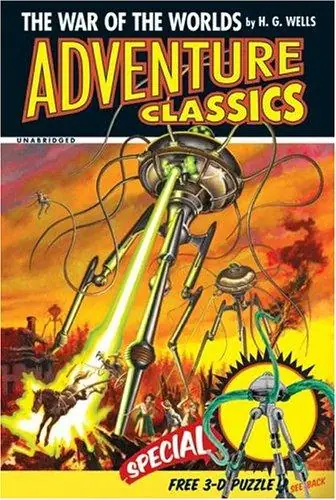
The War of the Worlds - H. G. Wells
Consult nearby libraries Buy this book The War of the Worlds, published for the first time in 1898, narrates for the first time in the history of literature a theme that will be recurring ever since and will give rise to an entire subgenre within science fiction: the hostile invasion of Earth by aliens from Mars, received by a naive humanity that will have to organize to prevent a massive destruction of the planet. Through this fable in which scientific descriptions, premonitions about the future of technology and the ins and outs of politics take center stage, H.G. Wells tells us about the vanity and fictitious security of a self-satisfied humanity, and the dangers that threaten its survival. When a Martian spaceship lands on Woking Common, humanity is terrorized by aliens in tall armored capsules who stalk the countryside on three legs. The machines wreak havoc on London and the southern counties, and the survivors are driven underground. Scientist John Nicholson tells how he was plunged into a paralyzing nightmare of absolute terror, savage madness and total destruction. Consult nearby libraries Buy this book Previews available in: Spanish English French Dutch Subjects Imaginary Wars and Battles, Juvenile Fiction, Space Warfare, Science Fiction and Fantasy, Fiction, Diseases, Martians, Invasions, Classic Literature, Open Library Staff Selections, open_syllabus_project, Science Fiction in English, Imaginary Wars and Battles in Literature, Mars (Planet), Science Fiction, Space Vehicles, Earth, English Romance, Fiction, science fiction, general, British and Irish Fiction (fictional works by an author), Fiction, fantasy, general, Children's fiction, Exams, Vocabulary, SAT (Educational Test), English language, Study guides, Fiction, action and adventure, Life on other planets, War stories, Extraterrestrial beings, fiction, Outer space, fiction, Literature, English literature, Extraterrestrial beings, Extraterrestrial beings, Fiction, Space war, Fiction, science fiction, action and adventure, Human and extraterrestrial encounters, Comics, strips comics, Wells, h. gram. (herbert george), 1866-1946, Adaptations, Graphic novels, Aladdin (legendary character), fiction, War, fiction, Adventures and adventurers, fiction, Imaginary wars, Novel, War, Life on other planets, fiction, Fiction, war and military, Imaginary wars and battles -- Fiction, Space war -- Fiction, Mars (Planet) -- Fiction, Imaginary wars and battles -- fiction, Space war - fiction, Pr5774 .w3 2005dx, 823.912, Long Now Manual for CivilizationPeople H. G. Wells (1866-1946) Showing 10 featured editions. See all 457 editions? Book details Editing notes The physical object Edition identifiers Job identifiers Source records Job Description The definitive science fiction classic: For over a hundred years, this gripping story of the Martian invasion of Earth has captivated readers with a combination of imagination and incisive commentary on the imbalance of power that remains relevant today. The style is revolutionary for its time and employs a sophisticated first- and third-person account of events that is both personal and focused on the holistic fall of Earth's society. The Martians, as evil, mechanical and unknown as they are, remain a daunting threat in today's society, where, despite gigantic advances in technology, humanity's hegemony over Earth has yet to be called into question. In Well's introduction to the book, where the character talks to the late Ogilvy about astronomy and the possibility of extraterrestrial life defeating "wild" (to them) 19th century Britain, is he implying that this is the truth and the destiny of humanity? It's up to you to decide...
When a Martian spaceship lands on Woking Common, humanity is terrorized by aliens in tall armored capsules who stalk the countryside on three legs. The machines wreak havoc on London and the southern counties, and the survivors are driven underground. Scientist John Nicholson tells how he was plunged into a paralyzing nightmare of absolute terror, savage madness and total destruction.
Previews available in: Spanish English French Dutch
Subjects
Imaginary Wars and Battles, Juvenile Fiction, Space Warfare, Science Fiction and Fantasy, Fiction, Diseases, Martians, Invasions, Classic Literature, Open Library Staff Selections, open_syllabus_project, Science Fiction in English, Imaginary Wars and Battles in Literature, Mars (Planet), Science Fiction, Space Vehicles, Earth, English Romance, Fiction, science fiction, general, British and Irish Fiction (fictional works by an author), Fiction, fantasy, general, Children's fiction, Exams, Vocabulary, SAT (Educational Test), English language, Study guides, Fiction, action and adventure, Life on other planets, War stories, Extraterrestrial beings, fiction, Outer space, fiction, Literature, English literature, Extraterrestrial beings, Extraterrestrial beings, Fiction, Space war, Fiction, science fiction, action and adventure, Human and extraterrestrial encounters, Comics, strips comics, Wells, h. gram. (herbert george), 1866-1946, Adaptations, Graphic novels, Aladdin (legendary character), fiction, War, fiction, Adventures and adventurers, fiction, Imaginary wars, Novel, War, Life on other planets, fiction, Fiction, war and military, Imaginary wars and battles -- Fiction, Space war -- Fiction, Mars (Planet) -- Fiction, Imaginary wars and battles -- fiction, Space war - fiction, Pr5774 .w3 2005dx, 823.912, Long Now Manual for CivilizationPeople
H. G. Wells (1866-1946) Showing 10 featured editions. See all 457 editions?
Book details
Editing notes
The physical object
Edition identifiers
Job identifiers
Source records
Job Description
The definitive science fiction classic: For over a hundred years, this gripping story of the Martian invasion of Earth has captivated readers with a combination of imagination and incisive commentary on the imbalance of power that remains relevant today. The style is revolutionary for its time and employs a sophisticated first- and third-person account of events that is both personal and focused on the holistic fall of Earth's society. The Martians, as evil, mechanical and unknown as they are, remain a daunting threat in today's society, where, despite gigantic advances in technology, humanity's hegemony over Earth has yet to be called into question. In Well's introduction to the book, where the character talks to the late Ogilvy about astronomy and the possibility of extraterrestrial life defeating "wild" (to them) 19th century Britain, is he implying that this is the truth and the destiny of humanity? It's up to you to decide...
OPEN_LIBRARY_LINK().webp)
.webp)
.webp)